● OPTIONAL TOOL · QUESTION THE EVIDENCE · KEY A
Ask the question in the context where it arose
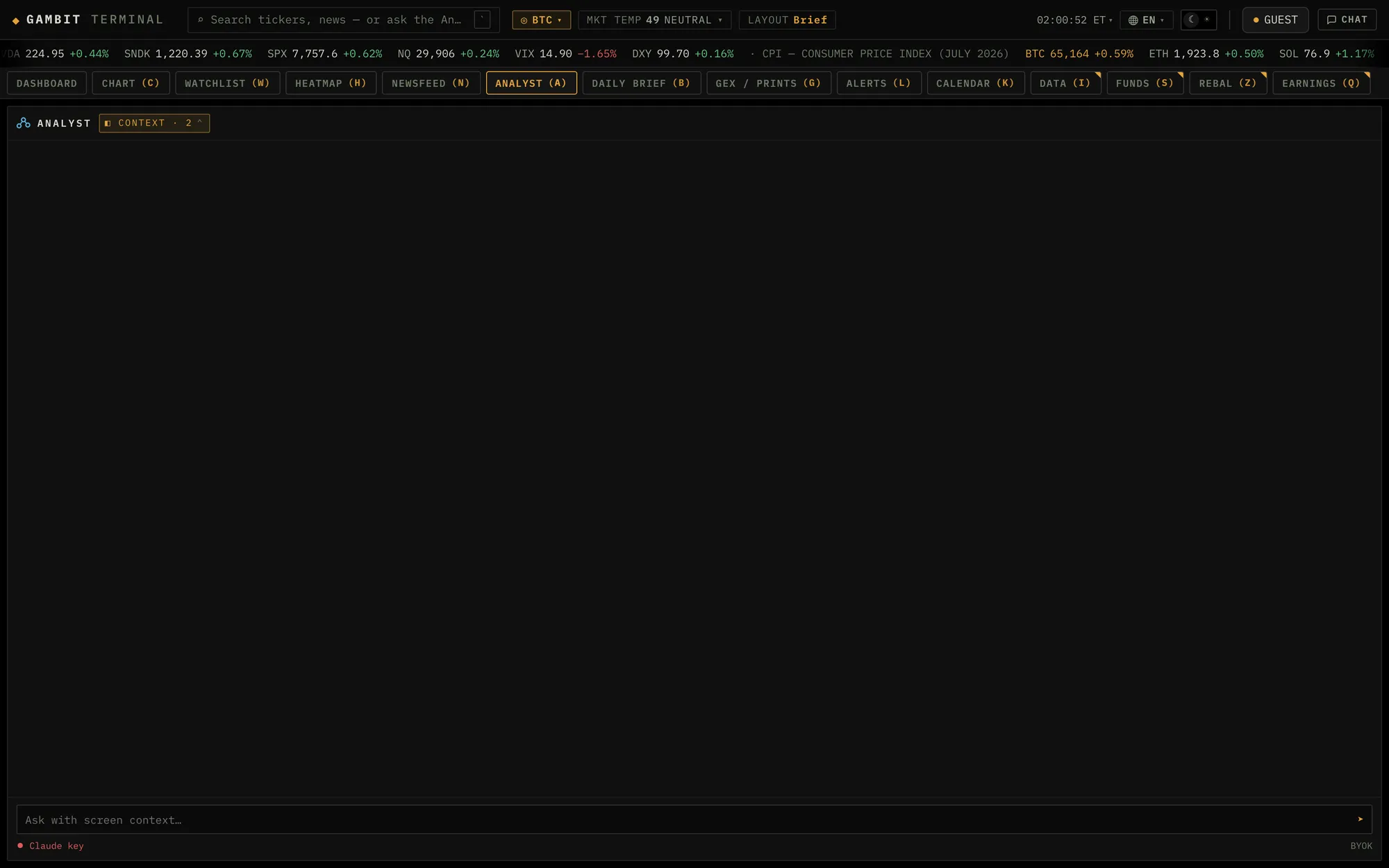
The Analyst can attach the chart, the newsfeed, the GEX profile or the DATA table currently on your screen to a request. You choose the model, you see the context chip before anything is sent, and the key is yours: Anthropic, OpenAI, OpenRouter or Gemini, held in your browser and never persisted by Gambit.
AS OF 10 AUGUST 2026 · SOURCE: GAMBIT · FIGURES BELOW ARE FROM A 10 AUGUST 2026 CAPTURE, NOT LIVE · CURRENT VALUES IN THE TERMINAL ↗
What it is for
A tool beside the loop, not a stage in it
The Analyst shortens the distance between noticing something and asking a useful question about it. It can summarise the evidence in front of you, compare values on the current desk, or help work out what would confirm an interpretation and what would break it.
It does not replace the source data, grade urgency, or make a trading decision. The calendar sets the expectation, the feed grades what arrived, the market desks show how far it travelled, and an alert watches what comes next. The Analyst helps you interrogate that evidence. It is not another source of it, which is the whole reason it sits beside the loop rather than inside it.
Used well
The questions worth asking it
Generic prompting produces generic answers. These are the shapes that work, because each one can be settled or refuted by something already on the screen.
- Was this event already on the calendar, and how does the print compare with the forecast?
- Is this move isolated to the ticker, or visible across its sector?
- Does the GEX profile suggest hedging would dampen this move or amplify it?
- Is this GPU price signal carried by enough quotes to mean anything?
- What on this screen contradicts the reading I have just formed?
- What condition would tell me I am wrong?
That last one is the useful habit. An answer you cannot invalidate is not analysis, and the condition it produces is exactly what an alert is for.
The trust boundary
Intelligence without surrendering control
Your relationship with the model provider stays direct. The key you paste is held in your browser's local storage and travels only with the request you choose to send. Gambit does not store provider keys server-side.
Because the key and the account are yours, so are the model choice and the bill: a frontier model for a thesis, a cheap one for summaries, on your own provider account with no markup from us.
Questions
How does the AI Analyst handle my API key?
The Analyst is bring-your-own-key (Anthropic, OpenAI, OpenRouter, or Gemini). Keys are stored only in your browser’s local storage and ride individual requests as headers. They are never persisted server-side: no save-keys endpoint exists, so there is no server-side copy to leak, to bill against, or to subpoena. You can verify the absence in your browser network tab, where no request carries your key to a Gambit host.
Does the Analyst decide what is urgent, or what to trade?
No. Urgency tiers are assigned by the newsfeed before an item is displayed, and the trading decision stays with you. The Analyst reads the desk on your screen and helps you question it: summarising the visible evidence, comparing values on the current desk, and working out what would confirm or contradict a reading. It is a tool for interrogating information rather than a source of it.
Which AI providers can I use?
Anthropic, OpenAI, OpenRouter and Gemini. You pick the model per task and pay your provider directly; Gambit adds no markup.
What context does the Analyst see?
The desk you are on, attached as screen context, shown in a context chip before sending. Nothing is sent until you ask, and requests go from your browser to the provider you configured.
Keep going