● MECHANICAL LENS · FORCED CLOSE FLOW · KEY Z
Leveraged ETF rebalance flows: the trade the close is forced to make
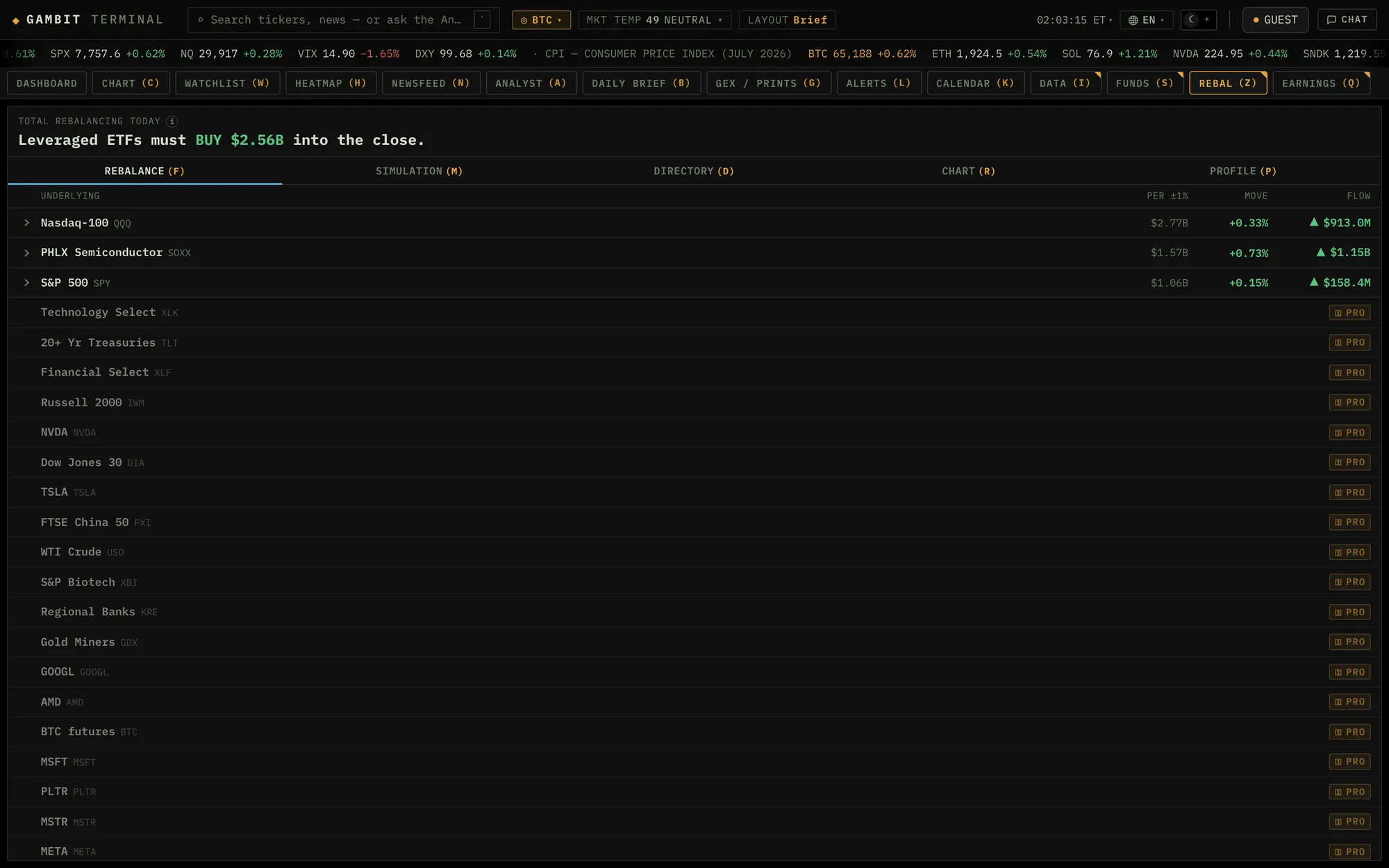
A 2× or 3× ETF has to reset its leverage every session, and the reset always trades in the direction of the day's move: gains force buying, losses force selling, for long and inverse funds alike. Gambit's rebalance desk sizes that obligation, totals it per underlying index, and shows a per-1% sensitivity so a trending afternoon can be read as the flow it is about to become. Key z.
AS OF 10 AUGUST 2026 · SOURCE: GAMBIT · FIGURES BELOW ARE FROM A 10 AUGUST 2026 CAPTURE, NOT LIVE · CURRENT VALUES IN THE TERMINAL ↗
How to read it
What this tells you, and what it does not
What this tells you
The size of a mechanical obligation created by the day's return and the assets sitting in leveraged and inverse products: how many dollars have to trade before the close, in the direction the market has already moved.
What it does not tell you
It is a first-order estimate under a simplified constant-leverage model, not a schedule of cash-equity orders. Funds reset exposure through swaps and index futures as well as stock, counterparties can hedge earlier or spread it out, and creations, redemptions, financing and fees all move the asset base the calculation rests on.
What to inspect next
Read it against the day's index move and the gamma regime. A large forced bid alongside short dealer gamma describes two mechanical flows leaning the same way, though neither explains the catalyst that started it.
The mechanism
Why the trade is arithmetic, not a decision
A leveraged ETF promises a multiple of its index's return for one day. To deliver that, the fund has to end every session holding exposure equal to the multiple times its net assets. Any move breaks the equality: the exposure it already holds changes by the size of the move, while its net assets change by the multiple times the move. Whatever sits between the two is the exposure the fund has to reset, and it resets near the close so the next day starts correctly levered.
Work it through on a 3× fund with $100m of assets, on a day its index gains 1%. The $300m of exposure it held is now worth $303m. Its assets have earned $3m, so they stand at $103m, and three times $103m is $309m. The fund is $6m short of its own mandate, and it has to buy that before the bell.
The general form is (L² − L) × assets × return, where L is the leverage multiple. That expression is positive for every multiple these funds are built on, which is the whole point: under the model the adjustment always runs the same way as the move. It is arithmetic rather than a view, and the resulting pressure lands on the exposure that has already moved, whether the fund reaches it through stock, futures or a swap counterparty.
Who trades most
Inverse funds rebalance hardest
Because the multiple is squared, an inverse fund rebalances more than a long fund of the same headline leverage. A −3× fund carries a coefficient of 12 against the +3× fund's 6, so it trades twice as much per dollar of assets. Even a plain −1× fund, which sounds unlevered, still rebalances.
They also trade the same way. On an up day the long fund buys to raise its exposure, and the inverse fund buys to shrink a short that has grown too large against a smaller asset base. Long and inverse flows on one index add together. They do not cancel.
| Fund | Coefficient (L² − L) | Per $1bn of assets, per 1% move |
|---|---|---|
| −3× inverse | 12 | $120m |
| +3× long | 6 | $60m |
| −2× inverse | 6 | $60m |
| +2× long | 2 | $20m |
| −1× inverse | 2 | $20m |
The desk
What Gambit shows into the close
The rebalance desk carries the total the leveraged complex has to trade today, broken out by underlying index, with a per-1% sensitivity beside it: how many further dollars join the obligation for each additional percent the index travels before the bell. A trending afternoon can be read forward instead of guessed at.
Treat the number as a sizing estimate, not a schedule of prints. Funds meet the obligation with total return swaps and index futures as well as cash, the dealers on the other side of those swaps hedge on their own timing, and creations or redemptions during the session move the asset base the whole calculation rests on.
One consequence is worth naming, because it explains the products themselves. Buying after gains and selling after losses is the definition of buying high and selling low, which is why a leveraged ETF erodes on a choppy path: a round trip that leaves the index flat can leave the fund down.
Questions
Why do leveraged ETFs have to rebalance every day?
Because they promise a multiple of a single day’s return, not of a longer period. Delivering that means ending each session with exposure equal to the multiple times net assets. Any move breaks the equality, since exposure changes by the size of the move while net assets change by the multiple times the move, so the difference has to be reset near the close. Under a simplified constant-leverage model that adjustment is approximately (L squared minus L) times assets times the underlying return.
How much does a leveraged ETF have to trade?
The obligation is (L² − L) × assets × return, where L is the leverage multiple. A 3× fund with $100m of assets on a 1% up day holds $303m of exposure against $103m of assets, needs $309m to stay at 3×, and so must buy $6m. Per $1bn of assets and a 1% move that is $60m.
Which direction is the flow?
Always the same way as the move, because (L² − L) is positive for every multiple these funds use. Gains force buying and losses force selling, for long and inverse funds alike, concentrated into the last part of the session.
Do inverse funds offset long funds?
No, they add to them. On an up day a long fund buys to raise exposure and an inverse fund also buys, to shrink a short that has grown too large against a smaller asset base. Inverse funds are the heavier rebalancers per dollar: a −3× fund carries a coefficient of 12 against a +3× fund’s 6.
What does the rebalance desk show?
The total dollar amount the leveraged complex has to trade today, broken down by underlying index, with a per-1% sensitivity showing how the obligation grows if the move extends into the close. It is a sizing estimate rather than a schedule of prints: funds use swaps and futures as well as cash, and creations or redemptions during the day change the asset base.
Keep going